Cxbladder® Triage
UC risk stratification optimised for patients presenting with microhaematuria.
Cxbladder Triage is an established test optimised for the risk stratification and rule of out of urothelial cancer (UC) in patients presenting with microhaematuria. Triage helps to de-intensify clinical work-up in those with a low probability Triage test result, reducing the need for referral and invasive procedures, while prioritising those who require further investigation.
Triage is included in the American Urological Association Microhaematuria Guideline¹, supported with "Grade A" evidence from the STRATA randomised controlled trial².
¹ Barocas et al. (2025) Updates to Microhematuria: AUA/SUFU Guideline (2025). The Journal of urology, 213(5), 547–557. https://doi.org/10.1097/JU.0000000000004490.
² Lotan et al. (2024) A Multicenter Prospective Randomized Controlled Trial Comparing Cxbladder Triage to Cystoscopy in Patients With Microhematuria. The Safe Testing of Risk for Asymptomatic Microhematuria Trial. The Journal of Urology Vol 212(1) 41-51.
• Analyses gene expression alongside information on known risk factors like age, gender and smoking history to help rule out urothelial cancer in those with a low risk of disease.
• Safely de-intensifies clinical workup in patients with a low probability Triage test result, while prioritising those who require immediate care.
| Step / Test | Accuracy | Notes |
|---|---|---|
| Sensitivity | 95% | |
| NPV | 99% |
Urine in Cxbladder container
30–50 mL midstream urine collected into the Cxbladder collection tube (contains preservative). Do not use catheter samples.
- First void urine (Only 2nd pass of the day or later is accepted)
- Grossly bloody urine
- Acute UTI (Treat UTI first and delay test for 2 weeks)
- <2 weeks after cystoscopy
- <6 weeks after BCG
Available through Codex Genetics as the authorised Pacific Edge distributor in Hong Kong. Please contact us for test kits, collection instructions, and ordering.
Cxbladder specimens must be collected using the dedicated Cxbladder collection kit.
- Request a collection kit from your healthcare provider or Codex Genetics.
- Collect midstream urine (30–50 mL) into the provided tube with preservative.
- Seal securely; store at room temperature.
- Deliver to Codex Genetics Laboratory within 5 days of collection. Address: Unit 220, 2/F, Building 16W, HKSTP, Pak Shek Kok, NT, Hong Kong.
Please contact us for pricing.
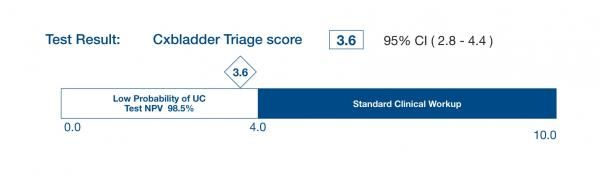
The Cxbladder Triage score ranges from 0.0 to 10.0. Using a cut-off of 4.0, it identifies patients who have a low probability of having UC.

Hong Kong-based molecular diagnostics laboratory specialising in clinical genomics, precision oncology, and rare disease diagnosis. Accredited to ISO 27001 and GenQA standards.
The services provided by Codex Genetics are for research use only, and they are not suitable for diagnostic and/or treatment use, unless otherwise instructed by licensed medical professionals.
除非有醫療專業人員另行指示,此網站的服務只供研究用途,並不供作診斷或治療任何疾病之用。
CoGenesis® is a trademark of Codex Genetics Limited
© 2026 Codex Genetics Limited. All rights reserved.